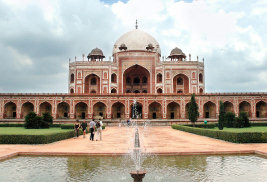
If the Taj Mahal is the culmination of the Mughal tomb architecture, Humayun’s tomb in certain ways is the beginning.
As people flock to vote in favour of the Taj Mahal as one of the Seven Wonders of the World, it is only appropriate to recall the sources of its design, especially one important building that preceded it by 75 years — Humayun’s Tomb in Delhi.
If Taj Mahal is the culmination of the Mughal tomb architecture, Humayun’s tomb in certain ways is the beginning. Humayun’s tomb is one of the early examples of a Mughal tomb set within an elaborate garden. The Mughal garden is usually divided into smaller squares by pathways and highlighted. This pattern known as char bagh was elaborately adopted in Humayun’s tomb and could be seen in Taj as well. This Mughal building was built in 1570 at the cost of rupees 1.5 m illion. Though many credit Haji Begum, the wife of Humayun as the patron, some historians think it was Akbar who actually built it.
Synthesis of two traditions
There is a conscious attempt to combine Persian and Indian elements in Humayun’s tomb. If the domes and façade treatment reflect the Persian influence, the chatris or open pavilions on the roof are typically Indian. In ad dition, the decorative motifs include satkona or star motif with a lotus inscribed in the centre. If this can be considered as a step towards synthesis of two architectural traditions, the absence of calligraphy on the facades is an attempt to address it to a larger section of the public. If Taj is a celebration in marble, Humayun’s tomb is a crafted grandeur in sandstone and marble.
The entire structure stands on a raised platform that enhances the monumental quality of the building. The tomb is placed in the centre of the platform and the design is based on a nine-segment plan known as hasht bihisht. Usually a square or rectangle is divided into nine segments and the centre space becomes the tomb hall. This is connected to the corner parts which are built up. This complex houses many royal tombs other than that of Humayun provoking a historian to categor ise it as the necropolis of the Mughals. It was here that Bahadur Sha Zafar, the last of the Mughal kings was captured by the British troops during the first war of Indian independent in 1857.
Humayun’s tomb was declared as a world heritage site in 1993.The Aga Khan trust, in 2003, funded to the tune of US $650,000 and helped restore the beautiful gardens of the tomb.
http://www.hindu.com/yw/2007/06/29/stories/2007062950210200.htm

 Ismailimail