Abu Ali al-Hassan ibn al-Haytham (965-1039), a distinguished philosopher, physicist, and mathematician, was born in Basra, Iraq, where he earned a reputation for his knowledge of applied mathematics.
Claiming to be able to regulate the flow of the Nile, he was invited by the Fatimid Caliph-Imam al-Hakim (r.996-1021) to assist with a hydraulic project at the current location of the Aswan Dam. However, al-Haytham was forced to concede the impracticability of the project. He spent the remainder of his years in Fatimid Cairo, residing close to the Al-Azhar mosque and centre of learning, founded by the Fatimid Caliph-Imam al-Mu’izz (r.953-975), continuing to work in his field now known as optics.
Early theories of vision claimed that light emanated from the objects into the eye in order to see the object. Although many challenged this theory, it remained until the year 1000 when Ibn al-Haytham developed a rigorous scientific theory of vision.
Although the principles of geometric optics were laid by Plato and Euclid – such as light travelling in straight lines – al-Haytham proved that light indeed travels in straight lines. He also developed mathematical models of reflection and refraction to prove his theories, urging others to repeat his experiments to verify his results and conclusions. It is generally agreed that Ibn al-Haytham was the first proponent of the modern scientific method earning him the title of “the first scientist.” He wrote several works including his influential seven-volume text Kitab al-Manazir (‘Book of Optics’), which was translated into Latin as De Aspectibus (‘Visible Aspects’) in the late twelfth or early thirteenth century. The work was printed by Friedrich Risner (d. ca. 1580) in 1572, as part of his collection Opticae thesaurus.
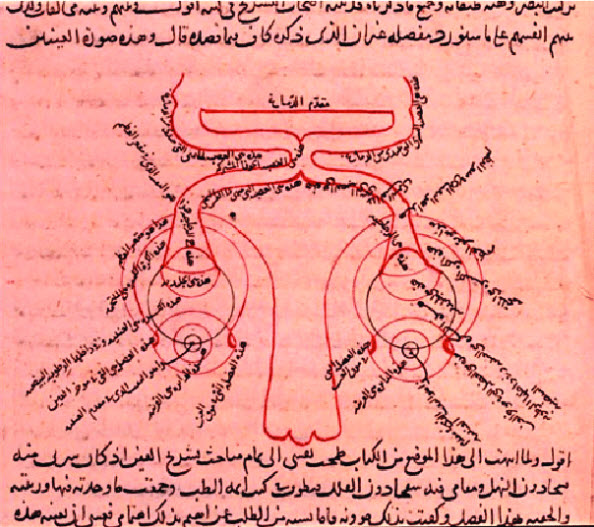
The Book of Optics became popular in Europe where Ibn al-Haytham was known by his Latinised name Alhazen or Alhacen.
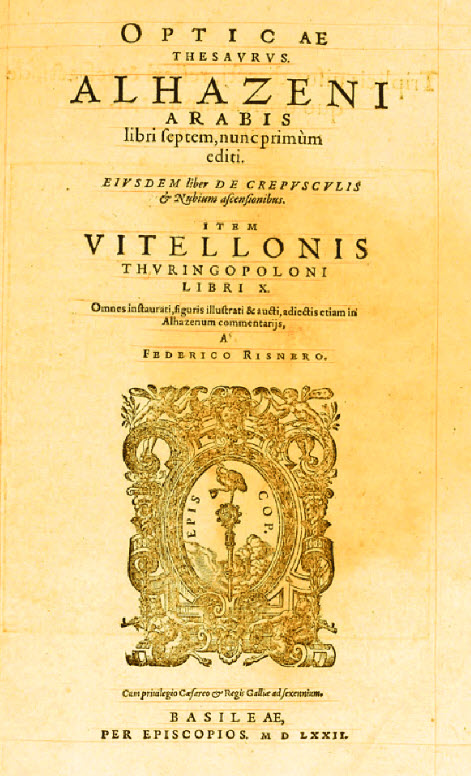
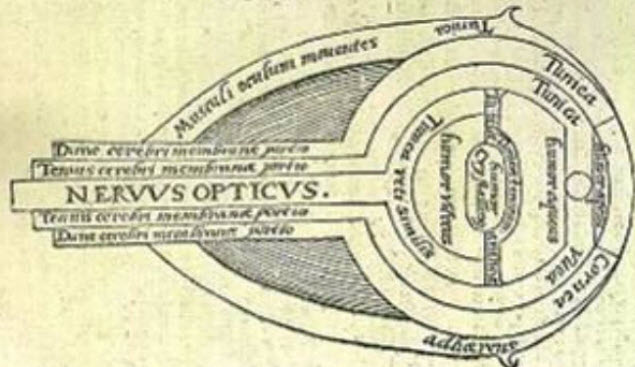
The English philosopher Roger Bacon (d. 1292) wrote a summary of De Aspectibus into a form that became historically important and remained the standard theory of vision until the work of Kepler (d. 1630).
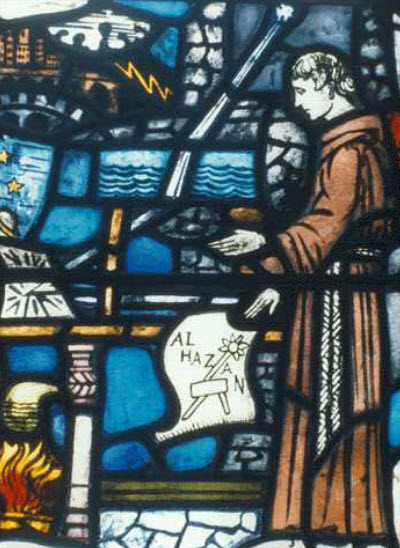
Marshal notes: “Unlike many of his time or predecessors, Alhazen was a diligent experimenter, verifying unproved theories first by experiment. He observed the magnifying power of spheres and lenses, and experimented with cylindrical, concave, and parabolic metal mirrors… His geometrical or optical theories were demonstrated by diagrams which aided lens- and spectacle-makers to produce reasonably accurate results…Kepler conceived the optical construction which gives an inverted image, and Scheiner made the first telescope which incorporated this inverted-image principle suggested by Kepler. This is probably the earliest intellectual contact between Alhazen and modern scientists. Kepler was a contemporary and friend of Galileo” (Astronomical Society of the Pacific Leaflets, February 1950).
“Few mathematical and scientific writings in the Middle Ages have been as influential as those of Ibn al-Haytham, whose works were also translated into Latin, Italian and Hebrew…. His mathematical works influenced Roger Bacon, Frederick of Fribourg, Kepler, Snell, Descartes, and Huygens and many others” (Rashed).
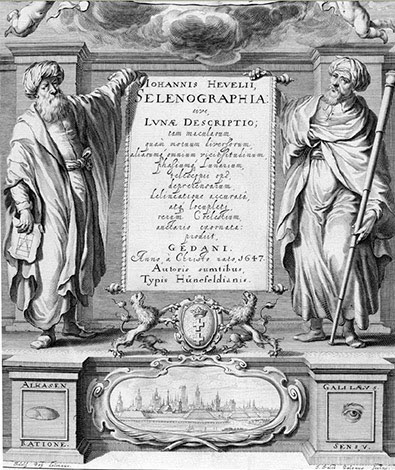
Among al-Haytham’s monumental contributions was his understanding of the crucial role of visual contrasts (for example, the contrast of the brightness levels explain why we cannot see the stars during the daytime) and proportions, which impact aesthetics. He also emphasised that psychology is as intimately involved in vision as the simple geometrical optics of the eye.
“For sight perceives beauty only from the forms of visible objects which are perceptible to it; and these forms are composed of the particular properties that have been shown in detail; and sight perceives the forms from its perception of these properties; and therefore, it perceives beauty from its perception of these properties.”
Ibn al-Haytham, Kitab al-Manazir, vol. 2, cited in Beauty and Islam p. 22
Gonzales states that with this new conception of vision and perception “appeared a new aesthetics, the aesthetics of light that was notably developed through the great programme of cathedral-building and the decisive problem of perspective in paintings” (Beauty and Islam p. 23).
The Latin texts of the Book of Optics were translated into Italian in the fourteenth century, titled Prospettiva (‘Perspective’), which was studied in the school of Padua in Italy. Biagio Pelacani da Parma (d. 1416), a renowned Italian philosopher, mathematician, and astrologer, assimilated Ibn al-Haytham’s work which, in turn, influenced pictorial representation in Renaissance art and spatial design in architecture.
Ibn al-Haytham’s works influenced art theorist and architect Leon Battista Alberti (d. 1472), author of the treatise On Painting (Della Pittura); the sculptor Lorenzo Ghiberti (d. 1455); and the artist Piero della Francesca (d. 1492). Al-Khalili notes that “they harnessed Ibn al-Haytham’s discussion on perspective to help create the illusion of three-dimensional depth on canvas and in friezes.”
Although Ibn al-Haytham wrote over 200 treatises and books, only about 50 have survived; a number of them have not been translated from Arabic. His numerous notable works include Risala fi al-dawʾ (‘Treatise of Light’), al-Hāla wa-qaws quzaḥ (‘On the Halo and the Rainbow’), Ṣūrat al-kusūf (‘On the Shape of the Eclipse’), and al-Ḍawʾ (‘A Discourse on Light’). In mathematics, he wrote about the area of crescent-shaped figures and on the volume of a parabolic revolution (formed by rotating a parabola about its axis). He also wrote on astronomy, music, ethics, politics, and poetry, and “defended astrology as a science based on mathematical proof…”(Sabra).
In 2014, the “Hiding in the Light” episode of Cosmos: A Spacetime Odyssey, presented by astrophysicist Neil deGrasse Tyson, focused on the accomplishments of Ibn al-Haytham, who came to be known as “the father of optics.”
In 2015, on the one-thousandth-year anniversary of Ibn al-Haytham’s Book of Optics, UNESCO declared it the International Year of Light in his honour.
A lunar crater was named after Ibn al-Haytham as is the asteroid 59239 Alhazen, in recognition of his enormous contribution to science.
Sources:
Anne A. Davenport, From Ibn al Haytham to Kepler, Boston College
Jim Al-Khalili, In retrospect: Book of Optics, Nature, International Journal of Science
O.S. Marshall, Alhazen and the Telescope, Astronomical Society of the Pacific Leaflets, Vol. 6, No. 251, p.4
Roshdi Rashed, A Polymath in the 10th Century, Science Magazine
Valerie Gonzalez, Beauty and Islam, Aesthetics in Islamic Art and Architecture, I.B. Tauris, London, 2001
Alhazen, Famous Scientists
Alhazen Builds the First Camera Obscura, History of Information
Biagio Pelacani da Parma e la perspectiva
Contributed by Nimira Dewji, who also has her own blog – Nimirasblog – where she writes short articles on Ismaili history and Muslim civilisations.
 Ismailimail
Ya Ali Madad.
Very nice & interested you sharing historic topics. I like.
LikeLiked by 1 person
This information is informative- nds to be given more exposure
LikeLike