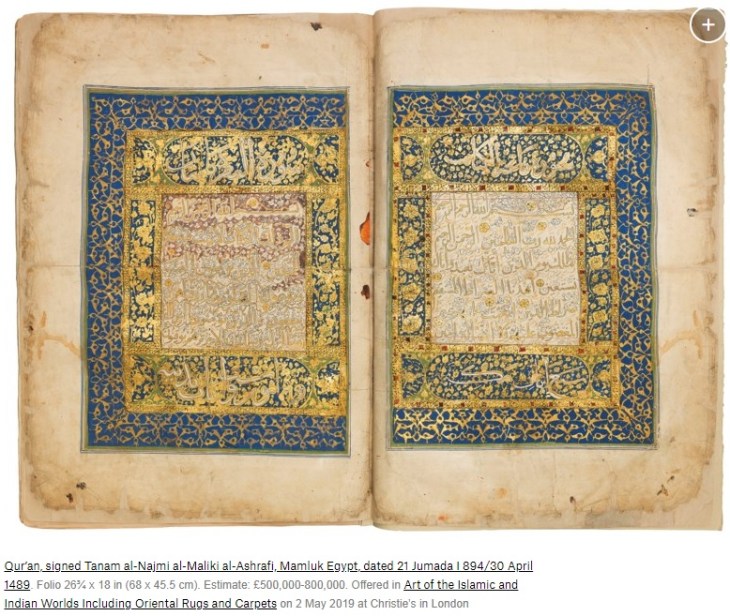
‘Mamluk Qur’ans of this size with a royal dedication are extremely rare. This is why they get so much attention when they come to market,’ says William Robinson, International Head of Islamic Art. The Qu’ran is offered in London on 2 May
According to William Robinson, International Head of Islamic Art at Christie’s in London, there are three primary factors that make this monumental royal Mamluk Qur’an extraordinary.
The first lies in its royal provenance. ‘From the dedicatory inscription on its double-page illuminated frontispiece, we know that this Mamluk Qur’an was made for the Sultan al-Malik al-Ashraf Sayf al-Din Qaytbay, who reigned from 1468 to 1496,’ states Robinson.
The inscription in gold thuluth, an elegant angular Islamic script, is painted on a lapis lazuli ground. ‘It’s rather unusual for a Qur’an dating to this period to come complete with its original and unrestored front and back pages, as well as the name and date of the scribe,’ explains the specialist. ‘Mamluk Qur’ans of this size with a royal dedication are extremely rare. This is why they get so much attention when they do come to market.’
For Robinson, Sultan Qaytbay of Egypt was the last great sultan of the Mamluk period (1250-1517). His reign — over an area that spanned present-day Egypt, Jordan, Palestine, Israel and Syria, as well as parts of Arabia — witnessed the last period of Mamluk stability and the construction of spectacular institutions and foundations across the region, from Cairo to Mecca.
Illuminated monumental Qur’ans were a speciality of the middle and later Mamluk periods and were often commissioned by Mamluk sultans as endowments for these institutions, where many still reside. This explains why there are very few Qur’ans of this size in private hands.

Read more at the source
Above is part of Christie’s auction event slated for May 2, 2019 in London, England under the event title Art of the Islamic and Indian Worlds including Oriental Rugs and Carpets.

 Ismailimail