Science and Religion in Islam: The Link.
By Easy Nash. Toronto, Ontario, Canada
 I thought this example from ‘Word of the Day’ used to properly define the word Demiurge is very good and it helps to explain why Greek philosophers like Plotinus (250 CE) in Alexandria, Egypt seized upon Platonic ideals (300-400 BC) from Athens, Greece and flavoured them with the seasoning of Judeo-Christian Monotheism the composite of which yielded Neoplatonism; it also explains why Ismaili Islamic cosmologists seized upon this rich composite making up Neoplatonism and drizzled it with Islamic monorealism to give an even richer composite of Philosophical Ismailism (800-1200 CE):
“In the Platonic school of philosophy, the Demiurge is a deity who fashions the physical world in the light of eternal ideas. In the Timaeus, Plato credits the Demiurge with taking preexisting materials of chaos and arranging them in accordance with the models of eternal forms. Nowadays, the word demiurge can refer to the individual or group chiefly responsible for a creative idea, as in “the demiurge behind the new hit TV show.” Demiurge derives, via Late Latin, from Greek dēmiourgos, meaning “artisan,” or “one with special skill.” The demi- part of the word comes from the Greek noun dēmos, meaning “people”; the second part comes from the word for worker, ergon. Despite its appearance, it is unrelated to the word urge.
Eastern Persian Dais Abu Yakub Al Sijistani, Shia Ismaili Muslim cosmologist during the time of Fatimid Imam-Caliph Al Muiz, and Nasir Khusraw, Shia Ismaili Muslim cosmologist during the time of Fatimid Imam-Caliph Al Mustansirbillah I, explain their cosmologies at their microscopic and nanoscopic levels:
“Tarkib’ is composition as in the compounding of elements in the process of making more complex things, that is, of adding together two things to form a synthesis, a compound. Soul composes in the sense of ‘tarkib’; it is the animating force that combines the physical elements of the natural universe into beings that move and act. Incorporating is an especially apt word in this instance. It means to turn something into a body, as in ‘composing’. But it is actually the conversion of an intellectual object, a thought, into a physical thing. Soul acts by incorporating reason into physical objects, the natural matter of the universe and all the things composed of it” (Abu Yakub Al-Sijistani,10th century Fatimid Ismaili cosmologist, d971CE, from the book, ‘Abu Yakub Al-Sijistani: Intellectual Missionary’, by Paul Walker)
“Every particle of the Creation has a share of the Command of God, because every creature shares a part of the Command of God through which it has come to be there and by virtue of which it remains in being and the light of the Command of God shines in it. Understand this!” (Abu Yakub Al Sijistani, 10th century Fatimid Ismaili cosmologist, d971, Kashf al-Mahjub(“Unveiling of the Hidden”))
“In fact this world is a book in which you see inscribed the writings of God the Almighty”(Nasir Khusraw, 11th century Fatimid Ismaili cosmologist-philosopher-poet)
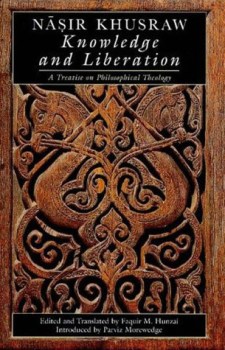
“O brother! You asked: What is the [meaning of] alam [world] and what is that entity to which this name applies? How should we describe the world in its entirety? And how many worlds are there? Explain so that we may recognize;alam is derived from [the word] `ilm(knowledge), because the traces of knowledge are evident in [all] parts of the physical world. Thus, we say that the very constitution (nihad) of the world is based on a profound wisdom”(Nasir Khusraw, 11th century Fatimid Ismaili cosmologist-philosopher-poet, from his book “Knowledge and Liberation”)
Know, O brother, that the name
http://gonashgo.blogspot.ca/2008/09/400blogpost-four-hundred-knowledge.html?m=1

 Ismailimail