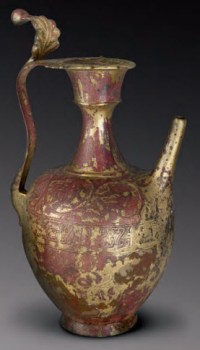
Metalwares, used in households for a variety of functions including at meals and banquets, were regarded as status symbols and a sign of a family’s prosperity. In ancient times, bronze household goods were prized for their beauty and durability. The metal’s shine depended on the specific alloy that was used. Early Islamic metal vessels were based on ancient models in a variety of shapes, mostly cast with embellishments such as simple grooves or Qur’anic inscriptions.
Aga Khan Museum

In the seventh and eighth centuries, royal courts developed a taste for luxury tablewares to display their wealth at festive banquets. However, the powerful rulers hoarded collections of gold and silver, and in times of economic crises, melted them to use in the minting of coins. Hence, few medieval metalworks have survived.
In the eastern Islamic lands, which were rich in silver, table silver was an essential item for court banquets. Many silver vessels were given colour through the processes of gilding or niello work. In the process of fire gilding, an alloy of gold and mercury was applied to the vessel. When it was heated, the gold fused to the surface and the mercury evaporated. In niello (from Latin: Nigellus, “blackened”) work, lines and grooves cut out of the background metal were filled with black silver sulfide, which was then fused to the surface by heating.

Trustees of the British Museum
The cities in the eastern Islamic regions, where there was plenty of silver and copper, offered perfect conditions for the widespread application of these techniques.
Over time, inlaid pen boxes and inkwells became accessories carried by the educated citizens. Often, images that reflected the scholarly life such as a game of chess, zodiac signs, or the symbols of the planets were added to the decorations.
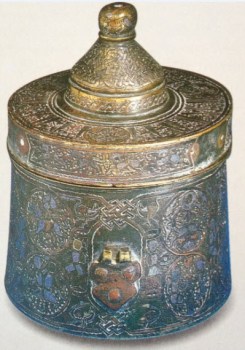
Craftsmen began to perfect the technique of inlaying, beginning a trend for the inlaying of complex figurative scenes. Although inlaid wares were no longer exclusively for the upper classes, they were still considered luxury goods for the wealthy. However, as the economies declined, these wares were eventually manufactured exclusively for export across the Mediterranean.
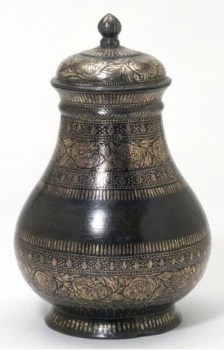
In Mughal India, products with a zinc content of more that 80% were popular and came to be known as “Bidri-ware” after the city of Bidar where they were made. Most of these items were bell-shaped or spherical, bearing deeply incised floral patterns which glittered with inlaid silver, gold or brass.
Steel screens and doors were given by rulers and wealthy individuals to shrines, especially those of the Shi’i Imams and their descendants. Beginning around 1307, elaborate screens, doors, and grilles were added to shrines.

This steel plaque would have been part of the work of a shrine door or decorative frieze with the names of the Shia Imams. The inscription Fatima al-Zahra (“Fatima the Radiant”), the name of the Prophet’s daughter is carved out in thuluth script on the intricately carved floral spiral that forms its background. Aga Khan Museum.
Sources:
“Metalwork,” Pattern and Light, Aga Khan Museum,
Almut von Gladib, “Islamic Metalwork,” Islam Art & Architecture, Edited by Markus Hattstein and Peter Delius, Koneman
Betsy Williams, Jane and Morgan Whitney Fellow, Islamic Metalwork, Department of Islamic Art, The Met Museum (accedded February 2017)
Compiled by Nimira Dewji
Previously on Ismailimail…




 Ismailimail