The dispensing of medicines and ointments – apothecary – developed into a highly skilled profession in the ninth-century Islamic society. From the Greek apotheke meaning ‘repository’ or ‘storehouse,’ it came to refer to the person dispensing medication, the ‘shop-keeper’ through the Latin apothecarius.
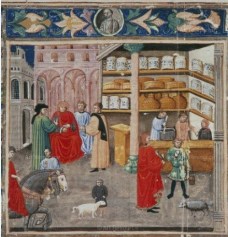
The medicine of medieval Islamic civilisations was derived primarily from Greek knowledge, particularly the writings of Hippocrates (460-370 BCE) and Galen (130-200 CE). With the expansion of Muslim rule, the pre-Islamic sciences of Greeks, Persians, Chinese, and Indians were incorporated into the Muslim intellectual traditions. Hence, a vast movement of translation and development took place in the eight and ninth centuries. Scholars and scientists from various religious and cultural backgrounds worked together, achieving philosophical, artistic, and scientific advancements which were subsequently transmitted to Europe and Asia.
In the medical field, the first apothecary shops, or pharmacies, were established in Baghdad in the eighth century. The medicines compounded from herbs and plants were stored in jars that were generally cylindrical and in-curved as they had to be easy to use and shelve, with wide openings for easy access. A piece of parchment or leather covered the mouth of the jar. The early apothecary jars were free of handles as they were not designed to hold liquids, however, later versions had ceramic lids, sometimes fitted with knobs and handles.

The jars and their contents were imported into Europe where they came to be known as alberelli (sing: alberello), from the term albaris, meaning ‘whitish,’ referring either to the white parchment on which the contents of the jars were noted, or to the white pottery glaze suitable for decoration that the jars were made from, produced in Iran or the Middle East before the ninth century.
Apothecary jars from Persia, Syria, and Egypt were introduced into Italy sometime before the fifteenth century. Although Syria is not necessarily the origin of this type of vessel, the Syrian albarelli produced under the Ayyubids (750-1258) in the north of the country at Raqqa, then, under the Mamluks (1250-1517), in the workshops of Damascus, were most commonly exported to Europe.
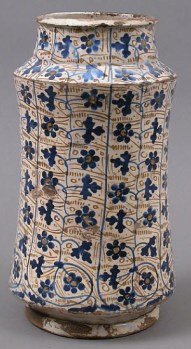
In the fourteenth century, the Spanish workshops produced similar jars, but gave them a lustre finish. These jars, often called damascene, were exported to England, Italy and even to Egypt. The albarelli from Damascus continued to be exported to the West, especially to Florence, which ordered them for its hospices.
Apothecary jars were sold primarily for their contents, not for the jars themselves as special or exotic objects, but they came to be valued as such in Europe; they served functional and decorative purposes. The fifteenth-century apothecary, regularly pictured in European paintings, was found chiefly in hospitals, courts, and monasteries; wealthy families had their own house apothecary.
Sources:
Pharmacy Jars (Albarelli), Aga Khan Museum (accessed April 2016)
A History of Pharmacy in Pictures, Washington State University (accessed April 2016)
Global Things (accessed April 2016)
ALMA Project (accessed April 2016)
Compiled by Nimira Dewji
 Ismailimail
Fascinating
LikeLike