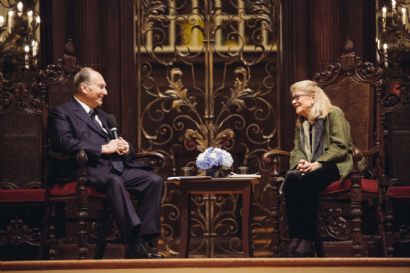
ECK: You ended with what is a remarkable theological foundation of pluralism. You began with the political situation of the world, and the multicultural situation of the Ismailis. So from all standards you have a basis for underlining pluralism as one of the most important issues in our world. But I think the theological understanding is one that may be new to many people who think primarily in terms of the practical issues of day-to-day life.
AGA KHAN: Right, right. Well I think that’s absolutely correct, and in fact this notion of one humanity in the faith of Islam is a very, very powerful force. But it’s not always presented in the form that I tried to present it today. And it is there, it is clear for those who wish to see it and understand it, but not all Muslim societies take that on board.
ECK: Well, it is interesting because Jewish, Christian and Muslim societies all are founded on theological principles that stress the oneness of God and also that begin with the theology of creation in the way in which you had. So there should be — and I think there has been — a kind of theological reaching out. I think especially of the Amman Declaration that you were part of, and of the message that was delivered called A Common Word Between Us and You, from so many Muslim leaders to Christian leaders across the country.
AGA KHAN: I hope that is true. I have been watching in parts of the world that has become a thought process. I am fearful of the parts of the world where that is not part of let’s say government philosophy, but I think that in time this understanding of unity of human society will end up by being seen as a condition sine qua non of good governance. I think you will see governments fail because they do not practice this principle. They will have so many divisions within them, so many attempts at achieving positions of power by certain groups or influence by others, that it will be impossible to create a sense of nationhood, a sense of building around common values, which after all is what most governments would wish to have.
Discover, Explore and Learn more by reading the complete interview transcript at: AKDN | Transcript of the intervew with Professor Diana L. Eck of Harvard University
 Ismailimail