Prince Sadruddin Aga Khan worked for United Nations High Commissioner for Refugees (UNHCR) before becoming High Commissioner. He led missions to the Middle East and Asia and served as Deputy High Commissioner from 1962 to 1966. By the time he was appointed High Commissioner, UNHCR’s expenditure in Africa and Asia exceeded that in Europe, marking a definitive shift from Europe to the developing world.
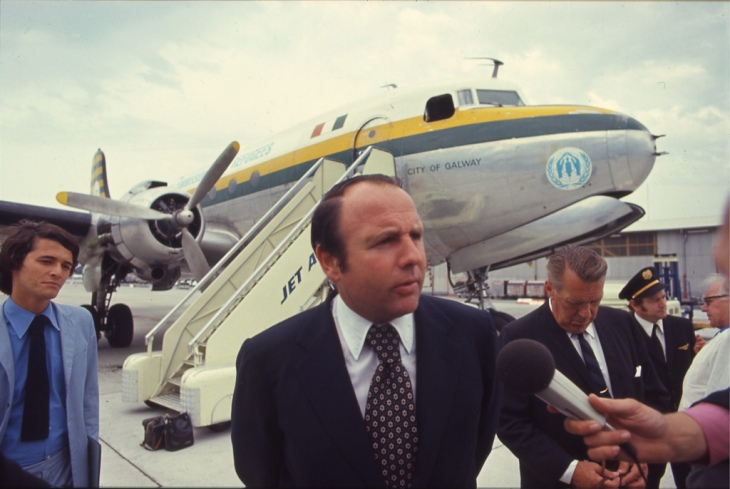
United Nations High Commissioner for Refugees Sadruddin Aga Khan being interviewed in front of the “City of Galway”. (Image credit: UNHCR / D. Vittet / June 1971)
He strengthened the organization’s relations with African governments and helped to improve inter-agency cooperation within the United Nations to address problems of mass displacement in sub-Saharan Africa and Asia.
He played a key role during the Bangladesh refugee crisis in 1971 and in assisting Asians expelled from Uganda in 1972.
Source: Archives of UNHCR | UN High Commissioner for Refugees | From van Heuven Goedhart to Guterres
Record for refugees: Prince Charles was given the record by the UN High Commissioner for Refugees Sadruddin Aga Khan (right) during a ceremony.
“Golden Soul”, the new long-playing record being sold for the benefit of the world’s refugees, has been getting strong public support in Europe and other parts of the world, partly due to participation by Head of State and other leading government officials and personalities in launching ceremonies.
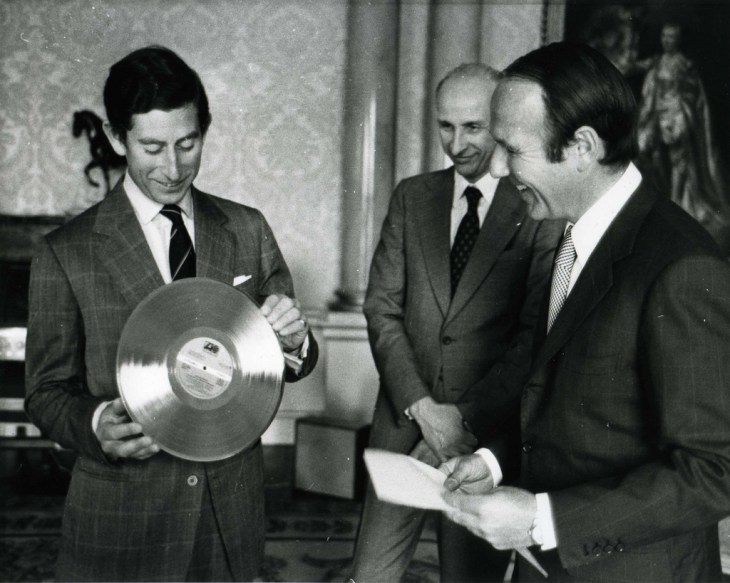
“Golden Soul” launchings a state affair in many countries including Australia, Austria, Belgium, Denmark, Finland, France, Germany, Greece, Iceland, Japan, Luxembourg, Netherlands, New Zealand, Norway, Spain, Switzerland, and UK.
Source: Archives of UNHCR | Record for refugees
In 1963, he served as UNHCR’s Deputy High Commissioner for three years before becoming the agency’s youngest-ever High Commissioner in January 1966 at the age of 33.
He was at the helm of the UN refugee agency during one of its most difficult periods. This included the 1971 Bangladesh crisis, which uprooted 10 million people; the 1972 exodus of hundreds of thousands of Hutus from Burundi to Tanzania; and the Indochinese boat people tragedy of the mid-1970s. In 1972, he played a key role in finding new homes for tens of thousands of South Asians expelled from Uganda by Idi Amin.

“He left an indelible print on UNHCR’s history – leading the agency through some of the most challenging moments.
Sadruddin’s name became synonymous with UNHCR.”
– Ruud Lubbers, UN High Commissioner
In his 12 years as High Commissioner – UNHCR’s longest-serving – Prince Sadruddin’s passion for the refugee cause was well known. “The refugee is a product of our errors, his predicament an indictment of our conduct as peoples and nations. He exists for our education and as a warning,” he told UNHCR’s Refugees magazine in 2000. “If there is one thing that is worse than being a refugee, it is being a refugee without asylum.”
After leaving UNHCR in 1977 at his own request, Prince Sadruddin founded the Geneva-based Bellerive Foundation to promote the protection of nature and the environment. He also served in various capacities on behalf of the United Nations – dealing with humanitarian situations like Afghanistan and Iraq during the first Gulf War – and was a trustee of several charity organisations.
The former High Commissioner published several books and received numerous national and international decorations, including the French Légion d’Honneur and the United Nations Human Rights Award.
Source: UNHCR | UNHCR mourns death of former chief Sadruddin Aga Khan
Image Gallery from Ismailimail Archives


 Ismailimail