Moti Khan, a nutritionist at the Aga Khan University Hospital, believed the solar oven model had a lot of potential: “Temperature control in varying external conditions and tweaking the system for optimal functionality can ensure its success in the long run.”
 By Haniya Javed / Creative: Jamal Khurshid
Published: May 19, 2015
KARACHI: For the rest of the world, a solar powered oven is not a new phenomenon. In Pakistan, however, not only is the majority unfamiliar with the concept, they are also missing out on how a small investment of less than Rs100 can work as an alternative means of cooking in both rural and urban settlements.
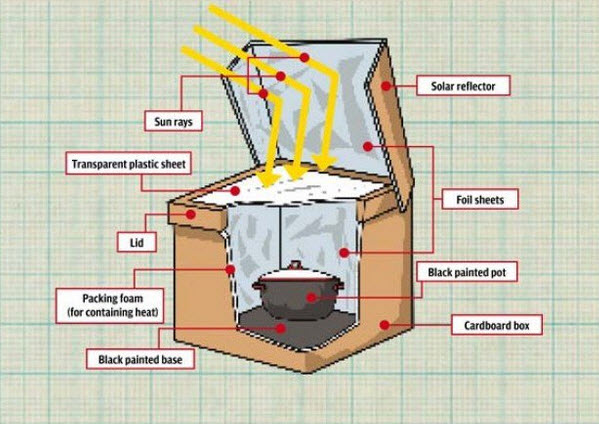
Azad Chaiwala, a researcher based in the UK, has designed a simple form of a ‘solar oven’. A cardboard box, plastic sheeting or glass, paper glue, styrofoam (polystyrene), aluminum kitchen foil, paper glue and black paint are the basic materials needed for this home-made appliance. According to Chaiwala, who hails from Azad Kashmir, there is no big investment required. “Ninety percent of the materials can be found in any home,” Chaiwala explained to The Express Tribune. “The polystyrene I used was from some old packaging. The plastic serving as a light inlet was actually a toy doll my daughter had recently received as a gift.”
In his sample model, Chaiwala fried an egg by maintaining a temperature at 87 degrees Celsius inside the foil-coated cardboard box. He then covered the lid of the frying pot, placed it inside the cardboard box and finally put the plastic-lined lid on the top the box, positioning the apparatus where it would receive maximum sunlight. “The temperature inside the box can be raised to 100 degrees Celsius, making it suitable for boiling water, pasteurising milk and making tea,” he explained. “The model can be tweaked to increase the temperature according to the requirement.

 Ismailimail