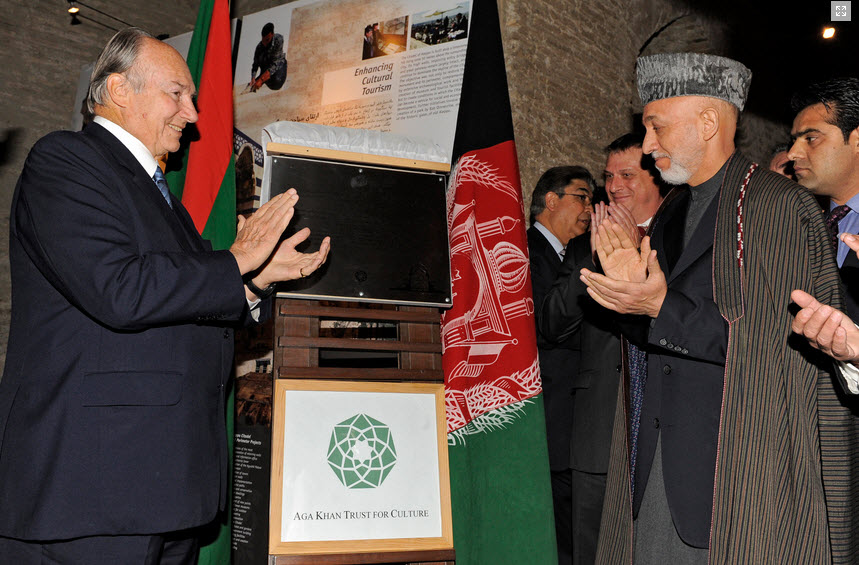
(Image: AKDN/Gary Otte)
One of the largest surviving Islamic monuments in central Kabul, the Mausoleum of Timur Shah marks the grave of the son of Ahmad Shah Durrani, who effectively united Afghanistan in the late eighteenth century. Born in 1746, Timur Shah served as governor of Herat and then moved his capital from Qandahar northeast to Kabul. His son Zaman Shah laid him to rest in 1793 in a garden on the banks of the Kabul River, but it was not until 1817 that the actual construction of the mausoleum began.
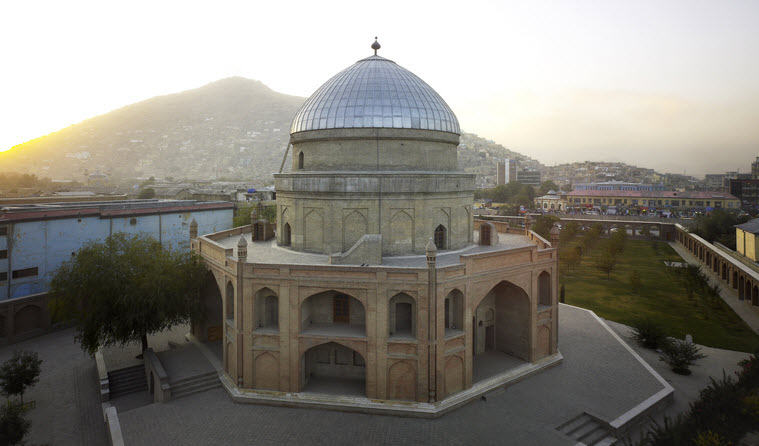
(Image: Archnet)
A perimeter wall has been constructed to protect the site, which has been planted with an orchard of mulberry trees – matching those seen in historic photographs – and laid out with paths for pedestrian access through the garden. The historic monument, which had fallen into disrepair during decades of civil war, has been restored as part of an on-going programme undertaken by the Aga Khan Trust for Culture to preserve the cultural heritage of Afghanistan. The work, which began in 2003, encompassed the mausoleum and the rehabilitation of the one hectare park surrounding the building.
Mawlana Hazar Imam and President Karzai officially opened the restored mausoleum on October 19, 2012.
At the Prince Claus Fund’s Conference on Culture and Development, in Amsterdam, in 2002, Mawlana Hazar Imam stressed the importance of the development work in Afghanistan:
“… the Aga Khan Trust for Culture is working in Kabul on the rehabilitation of the historic fabric of the ancient city, its monumental buildings, and traditional housing and decayed public spaces. These projects are centred around two significant historic sites: the Mausoleum of Timur Shah, considered by many to be the founder of modern Afghanistan, and the Paradise Garden of Babur, the founder of the Mughal Empire in the Indian subcontinent. The goals range from the lofty – the preservation and restoration of symbolic monuments of Afghan history and cultural identity, to the very practical – immediate employment opportunities and the rebuilding of marketable skills.”
References:
Timur Shah Mausoleum Restoration, Archnet
Aga Khan Development Network, Press Centre
Research by Nimira Dewji
 Be the First to Know – Join Ismailimail
Get breaking news related to the Ismaili Imamat, the world wide Ismaili Muslim community and all their creativity, endeavors and successes.
Inspired? Share the story
Want to inspire? Send your stories to us at Ismailimail@gmail.com
Subscribe and join 21,000 + other individuals – Subscribe now!
Earlier & Related from the Ismailimail Archives
 Mawlana Shah Karim: “The relationship between the Imam and his Jamat is a deep and continuing bond” - Indeed, those who pledge allegiance to you (O Prophet) – in fact they pledge allegiance…
 Mawlana Hazar Imam was gifted manuscripts on architecture of Andalusia, a Knowledge Society of its time - The fundamental reason for the pre-eminence of Islamic civilisations lay neither in accidents of history…
 Mawlana Hazar Imam Designates Ismaili Center Houston as Darkhana for US Jamat, the ninth Darkhana - (the light is lit) in houses of worship which God has allowed to be raised,…
 Imam Hasan ala dhikrihi’l-salam appointed Sinan as his deputy in Syria - Rashid al-Din Sinan, the greatest of the medieval Nizari Ismaili da’is in Syria, was born into a…
 The arts of the Fatimids, Mawlana Hazar Imam’s ancestors, continue to inspire - The official logo for Hazar Imam’s visits comprises the word nur, Arabic for light, repeated…
 Rumi: “The light that lights the heart is the Light of God” - Didar – A Persian word meaning ‘seeing” or “vision.” The vision can be experienced both…
 Pir Sabzali: “Hearing the farman, their eyes brimmed over with tears of joy” - After the fall of the Nizari Ismaili state of Alamut to the Mongols in 1256,…
 Ismailimail