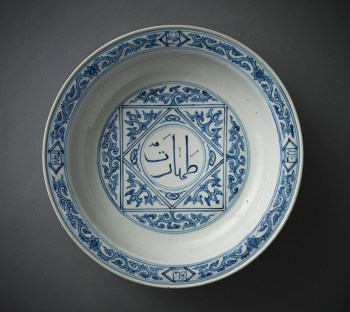
Ablution Basin Jingdezhen, China, 1506–21 Porcelain Diameter 41.8 cm, height 7.5 cm AKM722
“This exhibition beautifully shows that creative exchanges between China and the Islamic world were fully under way one thousand years ago,”– Alan Chong, Director of Singapore’s Asian Civilisations Museum
“The Lost Dhow exhibition is a natural fit with the Aga Khan Museum. The cross-cultural exchange exemplified by the dhow’s cargo is exactly what our collection and programming both celebrate and explore.
The Aga Khan Museum has an international outlook. Home to a collection of astonishingly beautiful works of art, it will showcase the artistic creativity and achievements of Muslim civilizations from Spain to China. I think local and international visitors will be greatly surprised when they discover just how much the arts of Muslim civilizations are a part of our shared global cultural heritage.”
– Henry Kim, Director and CEO of the Aga Khan Museum
Aga Khan Museum brings Toronto a new art vision
Published March 27, 2015 by editor
Walter Tautorat-Toronto: Last September The Aga Khan Museum opened their doors bringing over 1,000 pieces ranging from portraits to medical texts representing 10 centuries of human history inside Muslim civilizations. Their current visiting exhibition, The Lost Dhow: A Discovery from the Maritime Silk Route is an extraordinary collection that has to be seen.
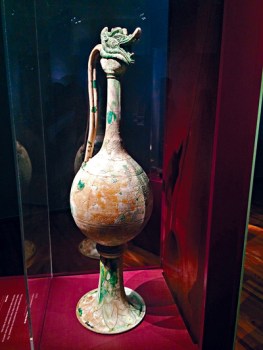
Discovered in 1998, the Lost Dhow sat off the waters of Belitung Island in the Java Sea filled with precious metals and over 57,000 pieces of Chinese ceramics. The ship had sat in the shallow waters for approximately 1,200 years. Historians were able to piece together the vast knowledge that had been shared between Tang China and the Abbasid Empire on the Maritime Silk Routes with this incredibly well preserved find.
The Aga Khan Museum is the first time that The Lost Dhow collection has traveled to North America and will be on display until April 25. The show has been guest curated by internationally renowned John Vollmer.
The Aga Khan Museum hosts several performing arts events and private functions. Live performances and films are an important part of the overall concept at Aga Khan. HIve Jam Sessions allow local artists and the public to improvise with visiting artists and artists-in-residents for inspiring sessions. The summer program is expected to be announced in the near future.
19th-century wooden panels hand-carved and painted in Damascus set the scene at the museum’s restaurant. Diwan at the Aga Khan Museum patrons can experience a fine dining lunch taking in a lovely view of the gardens. Chef Patrick Riley has created a tempting menu inspired by Turkey, Iran, North Africa, Central Asia, and the Indian subcontinent cuisine.
Capital Spain (Historic al-‐Andalus), 10th century Carved marble Height 28 cm AKM663
Shell With Inscriptions India (Historic Hindustan), 18th century Incised mother-‐of-‐pearl Diameter 14.5 cm AKM665
Planispheric Astrolabe Spain (Historic al-‐Andalus), 14th century Bronze inlaid with silver Diameter 13.5 cm AKM611
Ivory Horn (Oliphant) Southern Italy, 11th–12th centuries (mount: Great Britain, early 17th century) Carved ivory with silver mount Length 64 cm, height 34 cm AKM809
Ablution Basin Jingdezhen, China, 1506–21 Porcelain Diameter 41.8 cm, height 7.5 cm AKM722
Dish Iznik, Turkey, ca. 1570–80 Fritware, underglaze-‐painted Diameter 34.3 cm, height 7.4 cm AKM687
Qanun [Fi’l-‐Tibb] (Canon [Of Medicine]), Volume 5 Ibn Sina (d. 1037) Iran or Iraq, 1052 Opaque watercolor and ink on paper Folio: 21.2 x 16.4 cm AKM510 (image: Ismailimail/Aga Khan Museum)
School Courtyard with Boys Reading and Writing, Folio 149v of the Akhlaq-‐e Nasiri (Ethics of Nasir) by Tusi (d. 1274) Northern India (Historic Hindustan), 1590–95 Opaque watercolour, ink, and gold on paper 23.9 x 14.2 cm AKM288
The Court of Keyomars Folio 20v from a Shah-‐Nameh (Book of Kings) produced for Shah Tahmasp I Painting by Soltan Mohammad Tabriz, Iran, ca. 1522 Opaque watercolour, ink, gold, and silver on paper 47 x 32 cm AKM165
Rostam Pursues Akvan the Onager-‐Div, folio 294r from a Shah-‐Nahmeh (Book of Kings) produced for Shah Tahmasp I attributed to Mozaffar ‘Ali Tabriz, Iran, 1530–35 AKM162
 Walter Tautorat-Toronto: Last September The Aga Khan Museum opened their doors bringing over 1,000 pieces ranging from portraits to medical texts representing 10 centuries of human history inside Muslim civilizations. Their current visiting exhibition, The Lost Dhow: A Discovery from the Maritime Silk Route is an extraordinary collection that has to be seen.


![Qanun [Fi’l-‐Tibb] (Canon [Of Medicine]), Volume 5 Ibn Sina (d. 1037) Iran or Iraq, 1052 Opaque watercolor and ink on paper Folio: 21.2 x 16.4 cm AKM510 (image: Ismailimail/Aga Khan Museum)](https://i0.wp.com/ismailimail.blog/wp-content/uploads/2014/09/akm510_qanun.jpg?w=482&h=592&ssl=1 "AKM510_Qanun")


 Be the First to Know – Join Ismailimail


 Ismailimail
The Chinese bowl is a gem. When I think of how many pieces of china I’ve broken over the years, it’s a wonder these old pieces have survived at all.
LikeLike