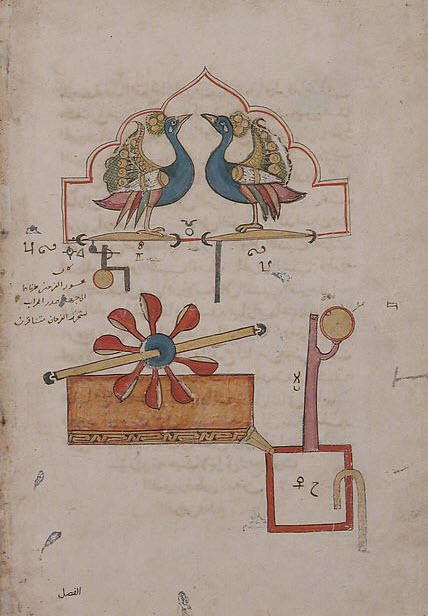
Image: Metropolitan Museum of Art
When Muslim rule expanded into the eastern Mediterranean regions and western Asia, they came into contact with the diverse pre-Islamic science and learning traditions of the Greeks, Persians, Indians, and Chinese. A vast movement of translation, development, and innovation took place between the eighth and ninth centuries where scientists and scholars from various religious and ethnic backgrounds worked together and achieved scientific advances.
Although several Arabic scientists worked in the field of mechanical devices in the eighth to the twelfth centuries, the most significant contribution in this field is al-Jazari’s work written in 1206. Badi al-Zaman ibn al-Razzaz al-Jazari (1136-1206) wrote his mechanical treatise, the Kitab fi ma’rifat al-hiyal al-hindasiyya (Book of Knowledge of Ingenious Mechanical Devices, also known as Automata). This book included descriptions of more than one hundred devices and gadgets invented by Al-Jazzari, and was compiled for the Turkish ruler, Sultan Nasir al-Din Muhammad, who had a great fascination for machinery.
Although many of al-Jazar’s devices such as water clocks and trick vessels, the descriptions of which occupy about three-quarters of the book, have little importance in the subsequent development of mechanical technology,the detailed descriptions of the individual components and the constructional techniques are of far greater importance since centuries later many of them entered the general vocabulary of European engineering. Among the most important of these components and techniques are conical valves, casting of brass and copper in closed mold boxes with greensand, static balancing of large pulley wheels, the use of wooden templates, segmental gears, and many others. Leonardo da Vinci is said to have been influenced by al-Jazari’s automation devices and gadgets.
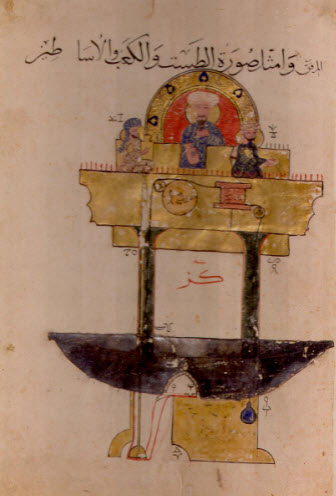
This folio, depicting a blood-letting device explained in the seventh chapter, comes from an Egyptian copy dated February-March 1354. The Arabic description at the top of the page reads: “And I am showing an illustration in the shape of a wash basin, the stand, and the cylinders.”
Blood-letting is the withdrawal of blood from a patient to cure or prevent illness and disease. Based on an ancient system of medicine in which blood and other bodily fluids were regarded as “humors” that had to remain in proper balance to maintain health, this practice was common until the nineteenth century.
In this painting, the patient puts a cut finger into a hole in the basin and blood falls through the channels into a lower chamber, displacing a float. The float is attached to one end of a rod that, on its other end, attaches to the pen in the hand of the scribe on the upper left. As the level of blood in the basin rises, it pushes the float up, moving the scribe’s pen and indicating the marks on his writing board.
References:
Aga Khan Museum Online Gallery
“Science and Learning,” Pattern and Light: Aga Khan Museum, Skira Rizzoli Publications Inc., New York 2014
Encyclopaedia Britannica
Research by Nimira Dewji
 Be the First to Know – Join Ismailimail
Get breaking news related to the Ismaili Imamat, the world wide Ismaili Muslim community and all their creativity, endeavors and successes.
Inspired? Share the story
Want to inspire? Send your stories to us at Ismailimail@gmail.com
Subscribe and join 20,000 + other individuals – Subscribe now!
Earlier & Related from the Ismailimail Archives
 Mawlana Shah Karim: “The relationship between the Imam and his Jamat is a deep and continuing bond” - Indeed, those who pledge allegiance to you (O Prophet) – in fact they pledge allegiance…
 Mawlana Hazar Imam was gifted manuscripts on architecture of Andalusia, a Knowledge Society of its time - The fundamental reason for the pre-eminence of Islamic civilisations lay neither in accidents of history…
 Mawlana Hazar Imam Designates Ismaili Center Houston as Darkhana for US Jamat, the ninth Darkhana - (the light is lit) in houses of worship which God has allowed to be raised,…
 Imam Hasan ala dhikrihi’l-salam appointed Sinan as his deputy in Syria - Rashid al-Din Sinan, the greatest of the medieval Nizari Ismaili da’is in Syria, was born into a…
 The arts of the Fatimids, Mawlana Hazar Imam’s ancestors, continue to inspire - The official logo for Hazar Imam’s visits comprises the word nur, Arabic for light, repeated…
 Rumi: “The light that lights the heart is the Light of God” - Didar – A Persian word meaning ‘seeing” or “vision.” The vision can be experienced both…
 Pir Sabzali: “Hearing the farman, their eyes brimmed over with tears of joy” - After the fall of the Nizari Ismaili state of Alamut to the Mongols in 1256,… Al-Tusi: “The ‘nass’ is not in order to make him an Imam; it is … so that people should recognise him as such” - “O Messenger, deliver [to the people] what has been revealed to you from your Lord,…
 Mawlana Hazar Imam Aga Khan V: “The Shia Ismaili Muslim community, of which I am the Imam, has been established in Syria for more than 1,000 years” - At the European Commission’s ninth annual conference in support of Syria, held on 17 March…
 Mughal Emperor Akbar’s pluralism is evidenced by an inscription of Hazrat Isa’s teaching on his “Victory Gate” - From the word ‘Mongol,’ the Mughals were a Muslim dynasty of Turkic-Mongol origin that ruled…
 Ismailimail