That’s why the Ismaili complex* is a challenge as well as a gift.
It represents an act of faith as much as an invitation to change.
It also suggests there is value where others have seen little or none. The effects have yet to be played out fully, but they will be transformative.
Not only will Canadians enjoy unprecedented access to Islamic history and culture, many will be thrilled that suburbia has turned a corner.
In raising the stakes so high, the centre has set an example that can’t be ignored. It’s here for good.
– Christopher Hume, concluding remarks
* Aga Khan Museum, the Ismaili Centre, Toronto and their unifying Aga Khan Park

Perspective on the Ismaili complex
(Aga Khan Museum, the Ismaili Centre, Toronto and their unifying Aga Khan Park)
In 21st-century Toronto, it’s not just what you build that matters, but where you build it. So when the new Ismaili Centre and Aga Khan Museum opened in September, locals were as surprised by the location of the project as by the project itself. The magnificent complex, what would be an architectural and cultural jewel in any city’s crown …
Perspective on the Architects
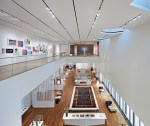
In addition to buildings by two of the world’s most acclaimed architects—the godfather of Indian Modernism, Charles Correa, and Pritzker Prize–winning Japanese practitioner Fumihiko Maki—the complex includes one of the world’s finest collections of Islamic art. In fact, the Aga Khan Museum is the first such institution in North America devoted to Islamic cultural artifacts. Its holdings range from centuries-old astrolabes and textiles to illuminated manuscripts and ancient ceramics, all of the finest quality.
Perspective on the unifying Aga Khan Park
If that weren’t enough, there is the exquisite set of gardens designed by Beirut-based landscape architect Vladimir Djurovic. Planted with more than 500 trees—mature trees—and more than 1,000 shrubs, these remarkable spaces stand in stark contrast to a city where everyone seems in too much a hurry to pay attention. This is a place of quiet contemplation and beauty that also knits the complex into a unified whole.
Perspective on the Ismaili Centre, Toronto
The heart of the complex is the Ismaili Centre, which serves as a gathering place, sacred and social, for the 30,000 Ismailis who live in the Toronto region. … Designed by Correa, [it] is a striking circular structure above which a large glass dome rises asymmetrically nearly 20 metres high. Unsurprisingly, it has quickly become a local landmark. In its own way, it has already put the neighbourhood and the street, otherwise banal Wynford Drive, on Toronto’s cultural map. The dome, which soars above the massive Prayer Hall, the spiritual hub of the compound, enhances the sense of spaciousness within and connection to the world without.
“I didn’t start by trying to find the identity of the centre, but by finding the axis mundi”—the place where heaven and earth meet—“and understanding the symbolism of the way the light comes into the room.”
– Charles Correa, Architect for the Ismaili Centre, Toronto
Perspective on the Aga Khan Museum
Toronto was chosen as the location of the Aga Khan Museum after plans to build it on property near the House of Commons in London, England, fell through. Though the decision meant that Correa had to realign and redesign the Ismaili Centre, the move was a huge coup for Ontario’s capital. Impressed by Toronto’s hyperdiversity and its tradition of acceptance, the Aga Khan decided to locate the museum and its priceless collection at the 6.8-hectare site in the early 2000s.
The official budget was $300-million, but no one would be surprised to discover it cost more. Not only are the materials the finest, the designers of the Ismaili Centre opted to excavate an underground garage to keep the grounds as free as possible from the ever-present parked car. Though it would be an overstatement to call the subterranean facility attractive, it certainly has more going for it than the average parking pit.
The most obvious example of a preoccupation with detail is the passageway that leads from the parking area to the museum; it has been transformed into a walk through a magical slide-show consisting of high-definition images of artworks on view in the gallery ahead. In this darkened space, the figures—many taken from the collection’s superb 17th-century Persian miniatures—come alive in unexpected ways. Created by Parisian exhibit designer Adrien Gardère, who also handled the museum displays, it is a brief but intense mood-setter. Eschewing the usual strategy of filling darkened galleries with objects under a spotlight, he opted instead for something much less precious.
The attention to detail puts the focus on the individual visitor, not the passing hordes.
The Aga Khan Museum would be an object of beauty regardless of location.
By Christopher Hume for Nuvo. Posted January 16, 2015.
Read the complete article and view 15 stunning photos of the Aga Khan Museum in the image gallery at:
Nuvo | Winter 2014 |Design | Features Of Note | Aga Khan Museum: A gleaming crown
About NUVO
Inspired by quality, NUVO is Canada’s premier lifestyle magazine, founded in 1998. It is our mandate to create an editorial environment that is stimulating, evocative, entertaining and informative, and relevant to both the amateur and the connoisseur. We share the NUVO reader’s discerning taste in travel, food and wine, film and TV, fashion, art, architecture, design, business, automobiles and music, and feature the finest in writing, photography, illustration, design, and production in print and online.
 Be the First to Know – Join Ismailimail
Get breaking news related to the Ismaili Imamat, the world wide Ismaili Muslim community and all their creativity, endeavors and successes.
Inspired? Share the story
Want to inspire? Send us your story(s) at ismailimail@gmail.com
Subscribe and join 20,000 + other individuals – Subscribe now!
The world is talking about the Aga Khan Museum & Ismaili Centre, Toronto.
Discover & Explore: See it, Experience it and Join the Conversation!
Earlier & Related from the Ismailimail Archives:



 Ismailimail