
Aga Khan Museum
In the medieval Muslim world, ceramic production achieved superior creativity through the artisans’ innovations in shape and design, as well as their techniques of decoration.
Medieval Muslim consumers and artisans considered Chinese ceramics par excellence when they came into increasing contact with these wares. In the late eighth century, the Abbasid court at Baghdad began to import large volumes of Chinese wares. The first school of ceramics was established in Baghdad in the ninth century to produce ceramics locally. While the early products of the Baghdad kilns attempted to imitate Chinese porcelains, the Muslim potters developed their own styles, producing multi-coloured wares of exquisite beauty. A new style know as “frit-ware” or “stone-paste” developed. This method involved the addition of large amounts of crushed quartz to produce the hard, white, translucent ceramic, in an attempt to imitate the Chinese porcelains.
One of the challenges of the Iraqi potters was the lack of ingredients, mainly kaolin, to make true porcelain, therefore, the potters invented a variety of shapes and decorative styles to please the court, including a modified form of glaze using local materials to produce ceramics that closely resembled the Chinese wares.
During the Fatimid period (909-1171), their capital, Cairo, became a vigorous centre of ceramic production. Fatimid ceramics were much sought after in Italy, where the bowls – bacini – were used as decorative items or as vessels for religious ceremonies.
In the twelfth and thirteenth centuries in Iran, the vibrant tradition of illustrated manuscripts influenced the development of a new style of glazed pottery with numerous colours and intricate designs.
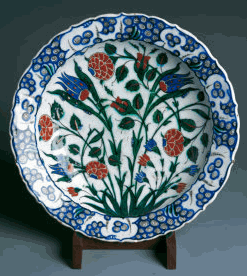
Under Ottoman reign, in the fifteenth and sixteenth centuries, the Turkish city of Iznik became a major centre of pottery making. Iznik was close to wood needed for kilns as well as other ingredients required for the production of ceramics. As a result, a distinctive style developed and came to be known as Iznik style: it involved combinations of a wide range of colours including cobalt blue, turquoise, green, black, and red.
The Aga Khan Museum’s collection includes a wide array of ceramics from various Muslim civilizations. Visit the Museum’s Online Gallery to view the diverse artistic wares that were produced.
References:
Fahmida Suleman, Ceramics, The Institute of Ismaili Studies
John Luter, The Potters of Islam, Aramco World
Research by Nimira Dewji
More:
- Mawlana Shah Karim: “The relationship between the Imam and his Jamat is a deep and continuing bond”
- Mawlana Hazar Imam was gifted manuscripts on architecture of Andalusia, a Knowledge Society of its time
- Mawlana Hazar Imam Designates Ismaili Center Houston as Darkhana for US Jamat, the ninth Darkhana
- Imam Hasan ala dhikrihi’l-salam appointed Sinan as his deputy in Syria
- The arts of the Fatimids, Mawlana Hazar Imam’s ancestors, continue to inspire
- Rumi: “The light that lights the heart is the Light of God”
- Pir Sabzali: “Hearing the farman, their eyes brimmed over with tears of joy”
- Al-Tusi: “The ‘nass’ is not in order to make him an Imam; it is … so that people should recognise him as such”
- Mawlana Hazar Imam Aga Khan V: “The Shia Ismaili Muslim community, of which I am the Imam, has been established in Syria for more than 1,000 years”
- Mughal Emperor Akbar’s pluralism is evidenced by an inscription of Hazrat Isa’s teaching on his “Victory Gate”
 Ismailimail