Humanitarian workers restore lives and dignity, but changes in the world demand that the sector reform itself to stay relevant.
Over the last 10 years, the number of people in need of humanitarian assistance has tripled;
- displaced people spend an average of 17 years in displacement;
- attempts to politicize humanitarian work has become all too common; and,
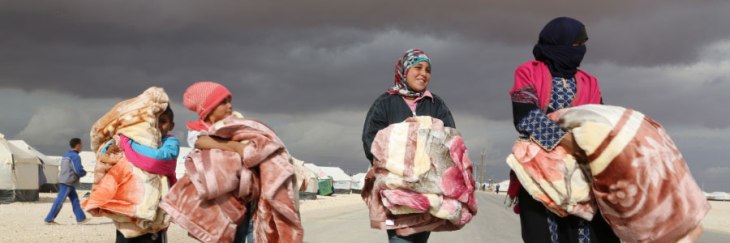
- finally, women and children are the face of the crisis.
– Valerie Amos, U.N. Under-Secretary-General for Humanitarian Affairs & Emergency Relief Coordinator
By Ruchika Arora Published Wednesday December 24th, 2014
Adaptation. Innovation. These two words are usually associated with the private sector. It’s a well-practiced mantra that business, management and employees must adapt and innovate in order to thrive in the frenetic global marketplace. Now there are signs that the humanitarian sector is cautiously following suit.
Made up of non-governmental organizations (NGOs) that deliver aid and assistance during human-made and natural disasters, the sector is vast. Ironically, it’s also at a crisis point: It not only faces more demands on its resources, but more complex problems related to climate change, conflict and extremism that simply have no easy solutions. To weather these changes, the Canadian humanitarian sector is coming together to learn how adaptation and innovation can improve its ability to respond effectively to the record number of people in need of assistance.
The second annual Canadian Humanitarian Conference, held at the Aga Khan Foundation of Canada in Ottawa from Dec. 4-5, was the result of intense collaboration led by the Humanitarian Coalition and its five core member NGOs: Care, Oxfam Canada, Oxfam Quebec, PLAN and Save the Children. Founded in 2007, the the coalition “brings together Canada’s leading aid agencies to finance relief efforts in times of international humanitarian crises”; it calls itself a “one-stop shop” for individual Canadian donors. The conference is also emerging as the one-stop shop for Canadian humanitarians to meet and exchange knowledge and know-how; yet, it’s also where humanitarians can build relationships with practitioners from vastly different sectors that wish to support humanitarian goals.
About Ruchika Arora
Ruchika Arora is a former activist-teacher trained in the International Baccalaureate system.
In 2013, she took the bold step of launching a freelance writing and research career whilst enrolled as an MSc sustainable development student with the Centre for Development, Environment and Policy at the School of Oriental & African Studies (UK).
Ruchika is presently involved with strategy development for the Toronto Sustainability Speaker Series. She is keen to see how the private sector expresses its commitment to genuine sustainability in Canada and abroad.
Ruchika is also an Associate at Open Spaces Learning, a Canadian change management firm helping companies realize business and social impact.
I’m not a humanitarian worker. I’m a budding sustainable development researcher who wishes to understand why humanitarian crises happen in the first place; that’s a challenging task.
I attended the conference to learn how my colleagues, bound by the humanitarian principles of humanity, impartiality, neutrality, and independence, perceive the impact of their work.
There is no question that we both wish crises could altogether be avoided. The reality is that we are both – researcher and practitioner – needed to help untangle the problems and identify root causes.
There remains a development-humanitarian divide that needs to be bridged.
Twitter: @Oh_Womyn. @OpenSpacesLearn
Discover, Explore and Learn more at http://www.triplepundit.com/2014/12/canadas-humanitarian-sector-gears-adapt-innovate/
Conference Organizers
About Humanitarian Coalition
Following the South Asian Tsunami of 2004, a number of Canadian relief organizations discussed the creation of a Canadian joint appeal mechanism. All of Canada’s principal humanitarian organisations were involved in the initial studies and discussions. Four of these organizations went on to found and pilot the Humanitarian Coalition. These were: CARE Canada, Oxfam Canada, Oxfam-Québec and Save the Children Canada.
Relying on the examples of European joint appeal mechanisms, the Humanitarian Coalition was formed initially in 2005 as a loose agreement between the four founding member agencies to pursue joint fundraising efforts in Canada for humanitarian disaster relief.
 Be the First to Know – Join Ismailimail
Get breaking news related to the Ismaili Imamat, the world wide Ismaili Muslim community and all their creativity, endeavors and successes.
Inspired? Share the story
Want to inspire? Send your stories to us at Ismailimail@gmail.com
Subscribe and join 19,000 + other individuals – Subscribe now!


 Ismailimail