 Nothing makes the heart flutter like a noble love story, and history contains a great many of them, writes Nevine El-Aref
“Love is composed of a single soul inhabiting two bodies” — Aristotle
Love is a blessing from God bestowed on humans. Throughout the ages, love stories have filled the world’s history books. Whether sad or cheerful, they have been told and retold from one generation to the next, prettified and dramatised by poets, sung and celebrated by people, and put on film.
However, some lovers have decided to leave a souvenir behind them that commemorates their story forever. They left tombs, temples and mausoleums that show how they loved each other to subsequent generations.
Among them were the New Dynasty Pharaoh Ramses II and his beloved wife Nefertari, the Ptolemaic Queen Cleopatra and her lover Mark Antony, Shah Jahan and Mumtaz Mahal in India, King Fouad I and his first wife Princess Shwikar, and Mohammed Shah Agha Khan and his wife Um Habiba.
[…]
Mohamed Shah Agha Khan and Um Habiba: The love story of Sir Sultan Mohamed Shah Aga Khan, the 48th Imam of the Ismailis, a Shiite sect, and his wife the Begum Um Habiba, started at the end of the 1930s.
Coincidence played a role in the marriage of the Aga Khan and his French wife, born Yvette Blanche Labrousse, who later became the Begum Um Habiba. They fell in love at first sight when they met at a royal dancing party in Egypt in 1938.
Labrousse was born in 1906 in the town of Sete in southern France to a seamstress and tramway worker. She won the title of Miss Riviera in 1930. While the love between the two faced many obstacles — the Aga Khan was 30 years older than she was — the couple were married in 1944 and Labrousse became the Aga Khan’s fourth and last wife.
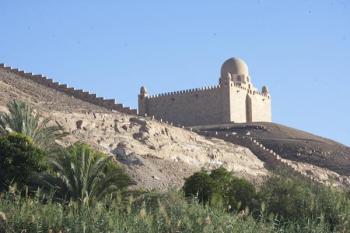
As Egypt was the place where they had first met, the Aga Khan built her a house in Aswan. Moreover, high up on the west bank of the Nile at Aswan stands the elegant pink granite mausoleum of the Aga Khan himself, built according to the Fatimid architectural style used in Cairo, with the tomb itself being made of white Carrara marble.
In his will the Aga Khan had expressed his wish to be buried there, and this took place after his death in 1957. Al-Attar said that Egypt had had a special place in the Aga Khan’s heart after his first visit there in 1935. His fourth wife, who died in 2000 and is buried beside her husband, used to put a red rose daily on his tomb.
Today, the mausoleum enjoys an excellent view, including of the Aga Khan’s white villa below and the nearby Monastery of St. Simon on the west bank at Aswan.
Source: http://weekly.ahram.org.eg/News/5377/47/Tombs-of-legendary-lovers-.aspx

 Ismailimail
It’s a wonderful love story. I hope someone makes a movie about it someday.
LikeLike