 Professor Eric Ormsby of Institute of Ismaili Studies, who has been reading, teaching and writing about the works of Abu Hamid al-Ghazali (1058-1111 CE) for almost thirty years, has written a book for the general reader on this influential theologian and mystic. The new book attempts to disentangle the many Ghazalis of legend and polemic to present him anew, in clear and readable fashion.
Ghazali remains a controversial figure almost a millennium after his death, not least for his unjust attacks on Ismaili teaching and doctrine. He is admired by many, Sunni and Shi‘i alike, but disliked by almost as many others. In Saudi Arabia, for instance, his books are banned.
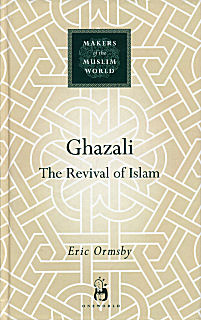 This book ‘Ghazali: The Revival of Islam’ was written as part of the series ‘Makers of the Muslim World’. Professor Patricia Crone, general editor of the series, invited Professor Ormsby to write on Ghazali. She wanted a book which “an intelligent astrophysicist” with no prior knowledge of Islam could read and enjoy. That meant no footnotes, no technical discussions, and not even any diacritical marks on Arabic or Persian terms—none of the features of the usual scholarly book. Professor Ormsby accepted the challenge and the result is this fascinating work.
In this book, the events of Ghazali’s life, including his famous nervous breakdown of 1095 CE, are discussed, as are his most important writings in law, theology, philosophy and Sufi mysticism. A useful feature of the book is the inclusion of Ghazali’s writing with many excerpts given, often in new translation. Professor Ormsby sets out to show the hidden coherence of Ghazali’s thought; he also offers fresh interpretations of certain of his most controversial doctrines, arguing, for example, that Ghazali’s notorious attacks on Ismaili teachings suggest that he was more deeply influenced by Ismaili thinkers than he acknowledged.
Source: http://www.iis.ac.uk/view_article.asp?ContentID=109272#

 Ismailimail
“In this book, the events of Ghazali’s life, including his famous nervous breakdown of 1095 CE, are discussed, as are his most important writings in law, theology, philosophy and Sufi mysticism. A useful feature of the book is the inclusion of Ghazali’s writing with many excerpts given, often in new translation. Professor Ormsby sets out to show the hidden coherence of Ghazali’s thought; he also offers fresh interpretations of certain of his most controversial doctrines, arguing, for example, that Ghazali’s notorious attacks on Ismaili teachings suggest that he was more deeply influenced by Ismaili thinkers than he acknowledged.”
Some have argued that his conversion to Sunni-based Sufi Mysticism is the direct result of his unrelenting and obsessive polemics against Shia Ismaili Muslim teachings, which, as we know, have the esoteric dimension of religion automatically built into their doctrines. I guess they subconsciously rubbed off onto him.
LikeLike
“Marshall Hadgson and Henri Laoust have both argued that the stirrings of what later developed into al-Ghazali’s existentialist posture (with the emphasis on religious experience) can be traced back to his engagement with the ta’lim doctrine, especially since the ta’lim doctrine, as much as al-Ghazali would wish it to be underplayed, culminated in an act of existential commitment to, and dependence on, the teacher. This interpretation brings to light one of the most fascinating ironies in Muslim intellectual history: that al-Ghazali’s reformation of Sunni Islam was in large part shaped by the ideas and ethos of the Shi’a Ismaili doctrine of talim.” Al-Ghazali and the Ismailis by Farouk Mitha
LikeLike
I would like to clear up a misconception that the reviewer may have. Ghazails works are not banned in Saudi Arabia,. I know because I recently had a friend coming from Saudia Arabia buy me a 5 volume set of the “revival”. Interstingly enough the version has footnotes from scholars that point out some of the hadeeth that are not considered to be valid in Ghazail’s work. In general I think Ghazili is tolerated by orthodox Islam and his works are sometime used by scholars to make a point but they have serious reservations about his use of Hadeeth that is not in bukhari , muslim et al.
LikeLike