The great respect for writing the revealed Word of God became a major form of artistic expression and production not only of religious but also secular texts including scientific and literary works as well as albums of portraits. Among the most esteemed artists were calligraphers and illuminators. However, illumination – the visual embellishment of written texts – added to the value of the book or manuscript.
In early times, the calligrapher was responsible for the illumination, but from the fourteenth century on, the craft became increasingly specialised. A luxuriously decorated book or manuscript was an object of respect as well as a collector’s item, which spurred the development of diverse forms of decoration including book bindings.
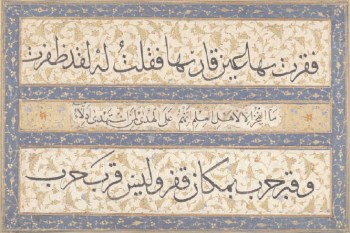
Often the luxurious books and manuscripts could only be afforded by royalty as the inks and elaborate time-consuming decorations were expensive. The courts of the great empires of the Safavids of Persia, Ottoman Turkey, and Mughal India employed a variety of calligraphers and illuminators to produce books on poetry, history, and sciences. Often, the princes and kings, who possessed extensive libraries, were also poets, calligraphers, and painters trained as part of their childhood education. Hence, artists needed to increase their skills in order to impress and succeed.
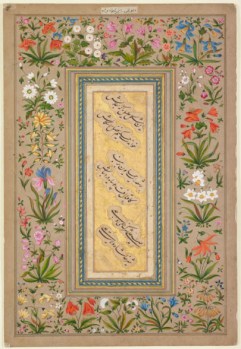
Although the art of protecting scripts is as old as writing itself, the contribution made by Persian craftsmen is particularly significant. Persian artists introduced a range of technical and artistic ideas that profoundly impacted the book production for centuries, not only locally but also in Europe.


A major impact on the arts of the book was made by the academy and library established by Baisunghur Mirza, a painter and an avid patron of the arts. Baisunghur greatly influenced the development of Persian miniature painting which in turn influenced the decoration of book covers transforming it into an elaborate art form.

Sheila Blair, Islamic Art (accessed July 2017)
Arts of the Book & Calligraphy, Treasures of the Aga Khan Museum (accessed July 2017)
Baisunghur Mirza’s Academy and Library, The Institute of Ismaili Studies (accessed July 2017)
Compiled by Nimira Dewji
 Ismailimail
Beautiful
LikeLike