Abu’l-Qasim Firdawsi (940-1020) completed his epic work, the Shahnama (Book of Kings), on February 25, 10101. Fearful that Persia’s history would be forgotten, Firdawsi set about composing a poem that integrated existing written accounts and orally transmitted tales.
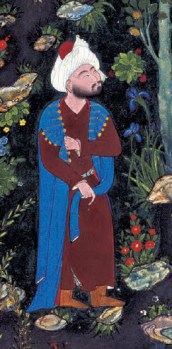
Partly legend, partly historic, the Shahnama comprises more than 60,000 rhyming couplets, telling the story of Persia (modern-day Iran) from the time of creation to its conquest by Muslims in the seventh century.
The first part tells of the mythical creation of Persia and its earliest mythical past; the second part tells of the legendary kings and heroes; the third part blends historical fact with legend, telling of the semi-mythical adventures of actual historical kings.
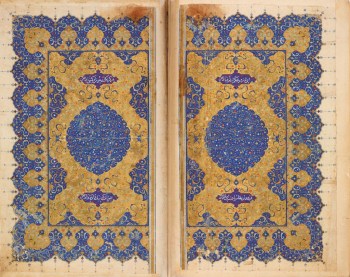
The Shahnama is organised according to the reigns of fifty kings (shahs). “Valued in its time as a work of history and for its ethical content (as a mirror for princes), the major themes of the Shahnama include the full range of human traits evidenced by rulers, their wise and foolish actions, the inevitability of human destiny, and the endemic jealousy of peoples living beyond Iran’s borders. Stories about each king’s life and rule, of the dilemmas and challenges they confront, alternate with those of heroes, such as Rustam, who dedicate their service to the kings. The kings’ reigns are assigned by God (Yazdan); so long as God’s appointed king rules Iran, in theory at least, Iran’s security and prosperity will be preserved.”1
Firdawsi began to compose his epic shortly after 975, at a time when eastern Iran came under Samanid reign (900-1005), ushering in one of the most brilliant periods in the cultural history of Iran. At their court in Bukhara, in present-day Uzbekistan, the Samanids supplemented Arabic with Persian language, initiating a Persian renaissance. By the time Firdausi completed the Shahnama, the Samanids had been overthrown by the Ghaznavids (r. 977-1186), ending the brief Persian renaissance.
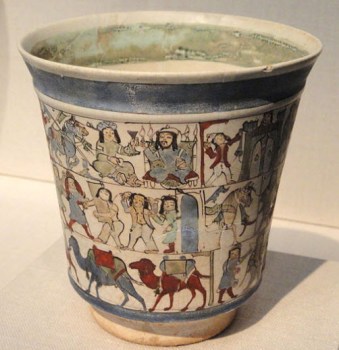
The Shahnama has also been an important source of influence on many works of art produced in greater Iran, as well as the eastern Islamic regions. Specific stories and characters were used as motifs to decorate ceramics, tile panels, inlaid metalwork, lacquer work, and textiles. Many rulers patronised lavishly illustrated copies of the Shahnama, and today their pages can be found in museums and private art collections around the world.
The Shahnama was copied in all the Iranian royal studios; copies were often made for rulers across the Persian-speaking world including the Mughal empire.
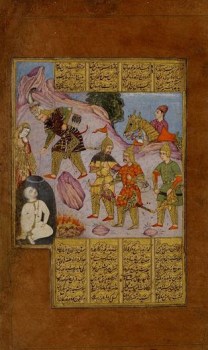
Over time, the Shahnama achieved unrivalled status and is considered “the most potent expression of Persian literary and national identity.”2
Sources:
1Treasures of the Aga Khan Museum, Masterpieces of Islamic Art, p 204, AKDN (accessed February 2017)
The Shahname, The British Library (accessed February 2017)
2Mario Casari, Firdausi’s Shahnama and the discovery of Persian in early modern Europe, Zoroastrian Heritage (accessed February 2017)
K. E. Eduljee, Ferdowsi’s Shahnameh, Zoroastrian Heritage (accessed February 2017)
Compiled by Nimira Dewji
Previously on Ismailimail…





 Ismailimail