During medieval times, iron and copper alloys were crafted into tools, weapons, and utensils, while gold and silver were made into jewellery, coins, and luxury items which became popular and were appreciated for their aesthetic appeal.

New buyers, who desired reasonably priced luxury goods, began to demand more intricate ceramics resulting in the development of many new techniques and styles.
However, due to the close and continuous contact between China, medieval Muslim consumers and artisans considered Chinese ceramics par excellence when they came into increasing contact with these wares. Chinese ceramics had a lasting influence on the pottery of the Islamic regions. Porcelain, textiles, and paper were primarily in demand in the Arab market while glass, spices, and minerals were exported to China.
The first school of ceramics was established in Baghdad in the ninth century. While the early products of the Baghdad kilns attempted to imitate Chinese porcelains, the Islamic potters developed their own styles, producing multi-coloured wares of exquisite beauty. A new style know as “frit-ware” or “stone-paste” developed. This method involved the addition of large amounts of crushed quartz to produce the hard, white, translucent ceramic, in an attempt to imitate the Chinese porcelains.
Art also travelled, and craftsmen in both regions were open to inspiration. The blue and white Chinese porcelain, in particular, had a decisive influence on Islamic techniques and decorations until modern time, inspiring the blue under-glaze painting that was invented by Persian artisans.
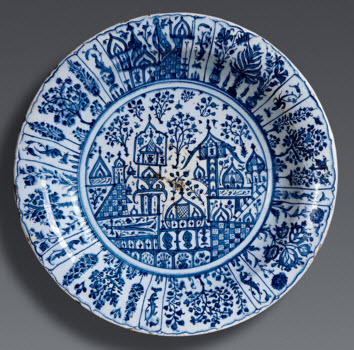
This plate, in the Aga Khan Museum’s collection, imitates Chinese ceramics. The scene shows small kiosks, onion domes, rows and columns of arches. It also contains the representation of the Prophet’s two sandals (na’layn) and the representation of Dhu al-faqar, the legendary two-pointed sword that belonged to Prophet Muhammad and was later given to the first Shia Imam, Hazrat ‘Ali, after the Battle of Uhud. Two standards and a number of suspended lamps also confirm the sacred nature of the place.*
Sources:
*Aga Khan Museum
Islam in China, The David Collection
Compiled by Nimira Dewji
 Ismailimail