London, United Kingdom, 22/10/2015 – His Highness the Aga Khan delivered the keynote address at a major conference of the International Council on Monuments and Sites (ICOMOS) on Thursday, 22 October 2015 in the United Kingdom.
His Royal Highness the Duke of Gloucester, Patron of ICOMOS-UK receives His Highness the Aga Khan for the 50th anniversary conference. (Photo AKDN / Anya Campbell)
ICOMOS has a special role as official adviser to UNESCO on cultural World Heritage Sites. Though the Historic Cities Programme of the Aga Khan Trust for Culture, the AKDN is experienced in leveraging the restoration of historic structures and the creation and rehabilitation of public spaces, parks and gardens as catalysts for social, economic and cultural development.
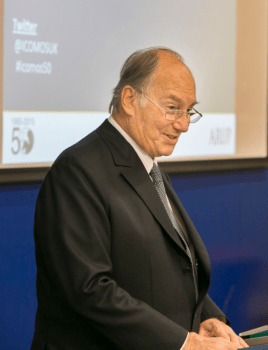
His Highness the Aga Khan delivers his Keynote Address at the ICOMOS 50th Anniversary conference in London. (Photo: AKDN / Anya Campbell)
What a pleasure it is for me to be marking with you the 50th anniversary of ICOMOS – happy birthday!
Yours is an organisation for which I have long had enormous respect. And I have noted with interest the impressive, recent development of your Cultural Heritage Manifesto.
The creation of ICOMOS 50 years ago came during my first decade as Imam of the Shia Ismaili Muslim community, and from the start many of my interests have closely resembled yours.
All Muslims are called upon to improve the physical condition of our world, and honouring our cultural heritage is vital to that calling. Our response in simple terms is that not a day goes by where my institution – the Ismaili Imamat – is not building or rebuilding something somewhere: a historic site perhaps, but also a hospital, a university, an industry.
Our central objective is to improve the quality of life for people in the developing world, and it is from this perspective that I will speak to you today.
Our work extends to 35 countries in fields such as education and medical care, job creation and energy production, media and tourism, the fine arts and micro-finance. We believe that by improving the largest numbers of variables in the shortest possible time, we can obtain stable, long-term improvement in the quality of human life.
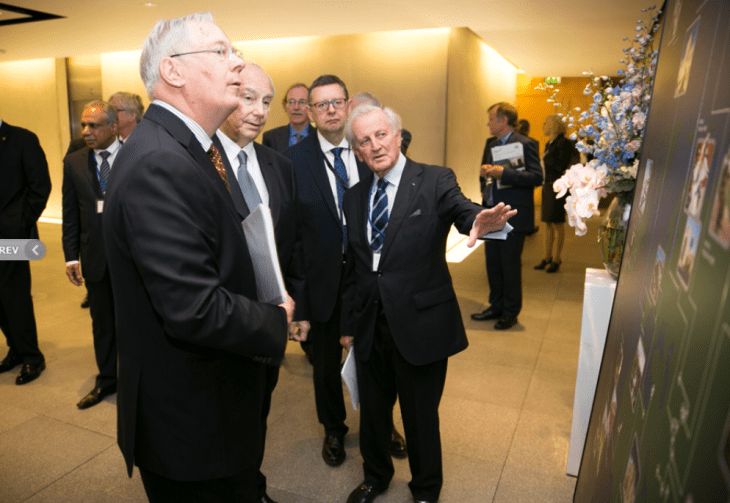
His Highness the Aga Khan and His Royal Highness the Duke of Gloucester review an exhibition of the work of the Aga Khan Trust for Culture (AKTC) with Luis Monreal, General Manager the AKTC. (Photo: AKDN / Anya Campbell)
Cultural heritage, of course, plays a central role in this endeavour. This focus was sharply intensified for me some 40 years ago when I came to realise that the proud architectural heritage of the Islamic world was progressively vanishing. The physical legacy of great Muslim empires was collapsing, and the response in the Islamic world seemed to be oblivion. What was in fashion, what was prized and taught throughout the Islamic architectural world, increasingly reflected Western preoccupations. Quality was viewed as occidentalisation. We searched throughout the Muslim world for any serious mention of Islamic architectural history and found none. There were no processes for revival, just the occasional misplaced dome or minaret.
Our time-honoured cultural heritage had been buried – obscured not only by the shifting sands of time, but also by an all-consuming occidentalisation. As one observer commented, the physical identity of the Islamic world had been reduced to coffee table books.
It was out of these concerns that the Aga Khan Award for Architecture was established in 1977, followed by the Aga Khan Trust for Culture and its Historic Cities Programme.
As our agenda grew over time – and most excitingly – we also came to another critical understanding. We began to see the added potential of heritage projects for advancing an economic and a social agenda, for fighting poverty and driving development. To be sure, this potential was often ignored as culture was too easily miss-labelled as a luxury amid pressing social and economic needs.
Discover, Explore and Learn by reading the complete Keynote Address at:

 Ismailimail