
(Image: 25 Years in Pictures)
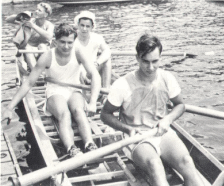
An avid athlete and skier at Le Rosey School and Harvard University, Mawlana Hazar Imam represented Iran in the men’s downhill skiing at the IX Olympic Winter Games at Innsbruck, Austria in 1964. Ismaili Imams have deep roots in Iran dating back to Alamut time.
(Image: 25 Years in Pictures)
After the fall of the Fatimid Empire, the Nzari Ismailis established a state centred at Alamut in northern Iran (formerly Persia). The fortress of Alamut is said to have been constructed by the rulers of the region in 860. According to legend, the ruler “was on a hunting expedition when he saw a soaring eagle alight on a rock. Noticing how strategically ideal the site was, the ruler decided to build a castle there that was henceforth called Aluh amu [kh]t, which may mean “the eagle’s teaching,” *
Hasan Sabbah acquired the castle in 1090, inaugurating the Alamut period in Nizari Ismaili history, which ended in 1256 when the Mongols destroyed the state. Subsequent to the fall of their state, the Imams went into hiding in order to avoid persecution, and lost direct contact with the community; many of them migrated to Afghanistan, Badakshan, and Sind in the Indian subcontinent. The Imams and the scattered Nizari communities in Persia guised themselves under the mantle of Sufi tarqahs that were spreading widely at the time. The common esoteric doctrines between Ismaili and Sufi tariqahs facilitated the Nizari-Sufi relationship – to outsiders, the Imams appeared as Sufi murshids, and their followers as murids.
By the middle of the fifteenth century, Ismaili-Sufi relations had become well established in Persia. The mutual interchange of ideas and terminologies between the Sufis and the Ismailis resulted in many similarities between their poetry and literature. The strong presence of the mystical tradition in Persia for centuries has had a significant impact on Persian literature and poetry. This explains why the Persian-speaking Nizari Ismailis have regarded several of the greatest mystic poets of Persia, such as Sanai, Farid al-Attar and Jalal al-Din Rumi, as their co-religionists, and have continued to use verses of these poets in their religious ceremonies.
The Nizari Imams emerged in Anjudan in central Persia in the mid-fifteenth century, initiating a revival in religious and literary activities. In 1817, Hasan Ali Shah succeeded to the Imamate. Fath ʿAli Shah (1797–1834), the reigning Qajar monarch of Persia, appointed the Imam to the governorship of the region of Qum and gave him one of his daughters, Sarv-i Jahan Khanum, in marriage. In addition, in 1818, the monarch bestowed upon the Imam the honorific, hereditary title of Agha Khan, later simplified to Aga Khan, which has been used by the Imam’s successors to the Nizari Ismaili Imamate. The next Persian monarch, Muhammad Shah (r.1834–1848), appointed the Imam Hasan Ali Shah to the governorship of the province of Kirman in 1835. This post had been held, for almost half a century, by the Imam’s grandfather, Abu’l-Hasan ʿAli (d. 1792).
Due to the changing political environment, Imam Hasan Ali Shah moved his residence, in 1842, to the Indian subcontinent, thereby ending the Persian period of the Nizar Ismaili Imamat, after seven centuries. The residence of Imams was established in Bombay (now Mumbai) and eventually in Europe. Mawlana Hazar Imam’s epicentre of Imamat and Aga Khan Development Network’s activities is at Aiglemont – French for eagle’s mountain.
In addition to the hereditary title of Ismaili Imamat, the terminologies and the literary traditions, the celebration of Navroz – the beginning of the Persian new year – is a permanent connection to the Persian period of Nizari Ismaili history.
Results of the performances of the downhill skiing at the Winter Olympics at Innsbruck can be found at SR/Olympic Sports
Prominent Harvard Alumni, Mawlana Hazar Imam noted as “Former Harvard soccer player” in the Government category.
Mawlana Hazar Imam skiing – You Tube
References:
*Shafique N. Virani, The Eagle Returns: Evidence of Continued Isma‘ili Activity at Alamut and in the South
Caspian Region following the Mongol Conquests, The Institute of Ismaili Studies
Farhad Daftary, Ismaili History, The Institute of Ismaili Studies
Research by Nimira Dewji
Related:
 Mawlana Shah Karim: “The relationship between the Imam and his Jamat is a deep and continuing bond” - Indeed, those who pledge allegiance to you (O Prophet) – in fact they pledge allegiance…
 Mawlana Hazar Imam was gifted manuscripts on architecture of Andalusia, a Knowledge Society of its time - The fundamental reason for the pre-eminence of Islamic civilisations lay neither in accidents of history…
 Mawlana Hazar Imam Designates Ismaili Center Houston as Darkhana for US Jamat, the ninth Darkhana - (the light is lit) in houses of worship which God has allowed to be raised,…
 Imam Hasan ala dhikrihi’l-salam appointed Sinan as his deputy in Syria - Rashid al-Din Sinan, the greatest of the medieval Nizari Ismaili da’is in Syria, was born into a…
More
 A Caregiver’s Advocacy Strengthens the Alzheimer’s Association — With Global Support from Icons like Taylor Swift, Tom Brady, Shohei Ohtani, Lionel Messi & more - A “from the heart” post from our reader! For the past 11 years, I have…
 Grand Prix de Chantilly Renamed in Honor of His Highness the Aga Khan: A Legacy of Excellence - March 27, 2025 The Grand Prix de Chantilly, one of France’s most prestigious horse racing…
 Global: Why the World Celebrates His Late Highness Prince Karim Aga Khan IV | Constellation of Honours: Over 300 Accolades from 55 Countries - Why the World Celebrates His Late Highness Prince Karim Aga Khan IV Throughout his life,…
 Italy: Sports Diplomacy Video Tribute | His Highness Prince Karim Aga Khan IV’s sincere wish that the Yacht Club Costa Smeralda would stand as an example and an inspiration - “We take this opportunity to remember with deep admiration and respect our Founder and President,…
More
 Ismailimail