Electricity prices to drop by 50%
WALTER WAFULA & JAN AJWANG
JINJA
BUJAGALI hydropower dam will cut the cost of electricity by more than half the current rate in the early stages of completion, His Highness Prince Karim Aga Khan has said.
The spiritual leader of the Shia Imami Ismaili Muslims, who was in the company of President Museveni, was speaking at the ceremony to lay the foundation stone for the Bujagali Hydro-Electricity Power Project in Jinja yesterday.
The Aga Khan Fund for Economic Development (Akfed), through its Industrial Promotion Services (IPS) arm, is one of two key shareholders in the Bujagali dam project. The project is run under the Bujagali Energy Limited consortium. Sithe Global is the other partner. The Aga Khan said that today only 5 per cent of the total population of Uganda, and a mere 1 per cent of the rural population, have access to the grid supply of electric power.
And even those who have access to electric power have suffered the burden of doubled tariffs over the last four years, let alone massive outages.
“But just imagine for a moment the transformation that can take place when the cost of power is cut by more than half, as it will be in the early stages of this project, and then is later cut in half again,” he said of the 250MW Bujagali project which is scheduled for completion in 2010.
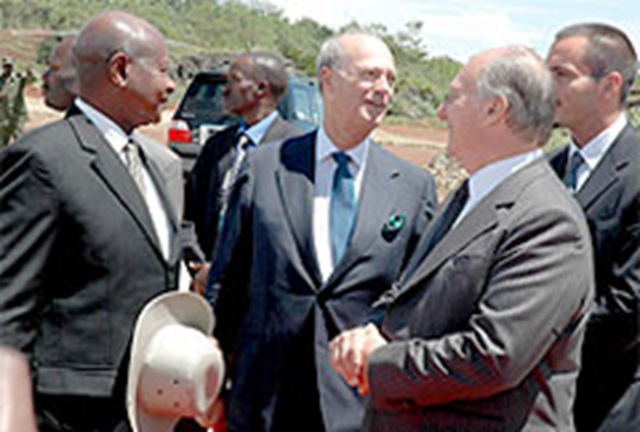 REAL HOPE: His Highness the Aga Khan (2nd R), his brother Prince Amyn Aga Khan (2ndL) and Prince Rahim Aga Khan (R) welcome President Museveni at the laying of the foundation stone for the Bujagali power project in Jinja. Photo by S. Wandera |
An initial 50MW of electricity from the dam will be generated after 36 months from September 2007 when construction begins in earnest. Electricity prices will start dropping once that 50MW comes on stream. The prices will continue to reduce as the subsequent 200MW is released onto the national grid monthly in four phases.
The reduction in power tariffs would shrink the cost of manufacturing, encourage investment, employment, enhance development, and improve Uganda’s overall economic growth.
The project is estimated to cost $772 million, excluding $43 million for any emergencies that may come up and $46 million which is debt service reserve.
The Ugandan government lent the project $75 million to commence work early enough as the international lenders processed the loan. The government also provided $17.5 million for resettling people along the Bujagali transmission line. Bujagali Energy Limited will pay the government back.
At a recent news conference, Dr Kevin Kariuki, the head of infrastructure at IPS, said Uganda is currently charged between 25-31 US cents for a unit (kilowatt-hour) of power.
“During the debt repayment period, tariffs will reach about 11 US cents per unit and over 30 years of approximately 6-6.5 US cents per kilowatt-hour,” Dr Kariuki said.
The soaring tariffs that Ugandans have endured in the previous years are partly associated with the high cost of generating thermal power. Thermal power plants in Kampala and Jinja currently produce 100MW by burning diesel.
These are supplementing the insufficient hydropower from Kiira and Nalubaale dams in Jinja. The country’s total power production currently stands at about 230MW while demand is estimated at 350MW. In other words, power supply has fallen behind economic growth.
The Aga Khan said that the current skyrocketing costs have worked to reinforce the cycle of poverty for millions, and badly impaired the ability of Ugandan companies to compete in international markets thereby curtailing the expansion of employment.
“The result of continuing power shortfalls can be a downward spiral of disappointment and discouragement,” he said.
The Bujagali power project is the largest single private sector investment in East Africa. It is also the largest independent power project in sub-Saharan Africa, and the largest single power investment ever made by the International Finance Corporation worldwide.
Bujagali Energy Limited has got all the money needed for the project from major world lenders. These include International Finance Corporation ($130 million), European Investment Bank (Euro100 million), African Development Bank ($110 million), Barclays Bank and Standard Chartered Bank ($115 million), Dutch Development Agency ($73 million), French Agency for Development ($73 million), and German Development Bank ($45 million).
President Museveni regretted the delay in the construction of the dam saying that it was one of the biggest mistakes he had made in his political career. Comparing himself to the Biblical Pontius Pilate who handed Jesus Christ to the Jews for crucifixion, the President said: “He participated in the killing of Jesus by keeping quiet. I didn’t reject [the sabotage of the project]. I just kept quiet. It was my mistake to keep quiet and like Pontius Pilate I confess and repent all my sins.”
He promised that the current energy crisis would not reoccur. “This is sabotage, it is criminal and I assure you that it will not happen again as long as the Movement is in power.”
Mr Museveni accused foreign environmentalists and the international community “especially in European and American governments” for fuelling the delay of the power project that should have started 15 years ago.
The President has also previously blamed opposition-leaning members of the Sixth Parliament (1996-2001) for the delay. He said that the current power crisis has made the government to revise its energy supply strategies.
“We are not going to accept the strategy of chasing demand of electricity; instead we must produce it ahead of demand,” he said.
The government recently established the Energy Fund to generate money locally to support power projects.
The strategy involves exploiting alternative energy sources such as biomass, solar, wind, and geothermal. Addressing himself to the concerns of environmentalists opposed to the dam, the President said the best way to protect the environment was to provide cheap energy so that people can stop using firewood. The Aga Khan also spoke of the environmental cleanliness of the project. He said hydropower is “clean energy” that advances sustainable development while minimising its environmental impact.
Uganda is not the only African country that is facing a power crisis. The New York Times reported in July that some “25 of the 44 sub-Saharan nations face crippling electricity shortages, a power crisis that some experts call unprecedented”.
Bujagali is one of the landmarks on the last leg of the Aga Khan’s 12-day East Africa tour in celebration of his Golden Jubilee as Imam of 15 million Shia Imami Ismaili Muslims who live around the world.
Today, he will lay a foundation stone for the Aga Khan Academy in Munyonyo, Kampala. The $50 million academy will devote its programmes to expanding access to education of international excellence for exceptional students in Uganda.
Through Akfed, the Aga Khan is also set to invest in an airline that will ease air transport in Uganda.

 Ismailimail